The Australian Two Dollar Coin: A Comprehensive Collector’s Reference for 2026
March 27, 2026
Could the loose change currently sitting in your car's console actually be worth A$500 or more? You've likely seen sensationalist social media posts claiming every second "error" coin is a small fortune. This misinformation makes it difficult to distinguish between common circulation pieces and genuine numismatic rarities. For the serious collector, understanding the australian two dollar coin requires a focus on verified data rather than online hype. Whether you're holding a 2012 Red Poppy or a low-mintage 2011 issue, the difference between face value and a significant premium often comes down to a few precise details.
We understand the frustration of sorting through conflicting advice while trying to value your heritage pieces. This reference provides the definitive data you need to identify true investment-grade treasures, focusing on historical significance, verified mintage figures, and current market values. We'll examine the specific low-mintage years that command a premium, the impact of circulation wear on your collection's worth, and how to secure an expert appraisal. By the end of this guide, you'll have the professional clarity required to manage your collection with confidence.
Key Takeaways
Trace the historical transition from the green decimal banknote to the aluminium-bronze $2 specimen, including the cultural significance of the "Guluu" elder design.
Identify the scarcity framework behind the australian two dollar coin, focusing on why the low-mintage 2011 and 2012 standard issues command a premium.
Evaluate the market trajectory of coloured commemorative releases, from the landmark 2012 Red Poppy to modern Coronation and Remembrance themes.
Learn to recognize valuable minting errors, such as clipped planchets and off-centre strikes, that turn ordinary pocket change into rare numismatic treasures.
Master professional investment strategies by understanding how PCGS grading and authenticated provenance impact the long-term liquidity of your collection.
The Genesis of the Australian Two Dollar Coin (1988–2026)
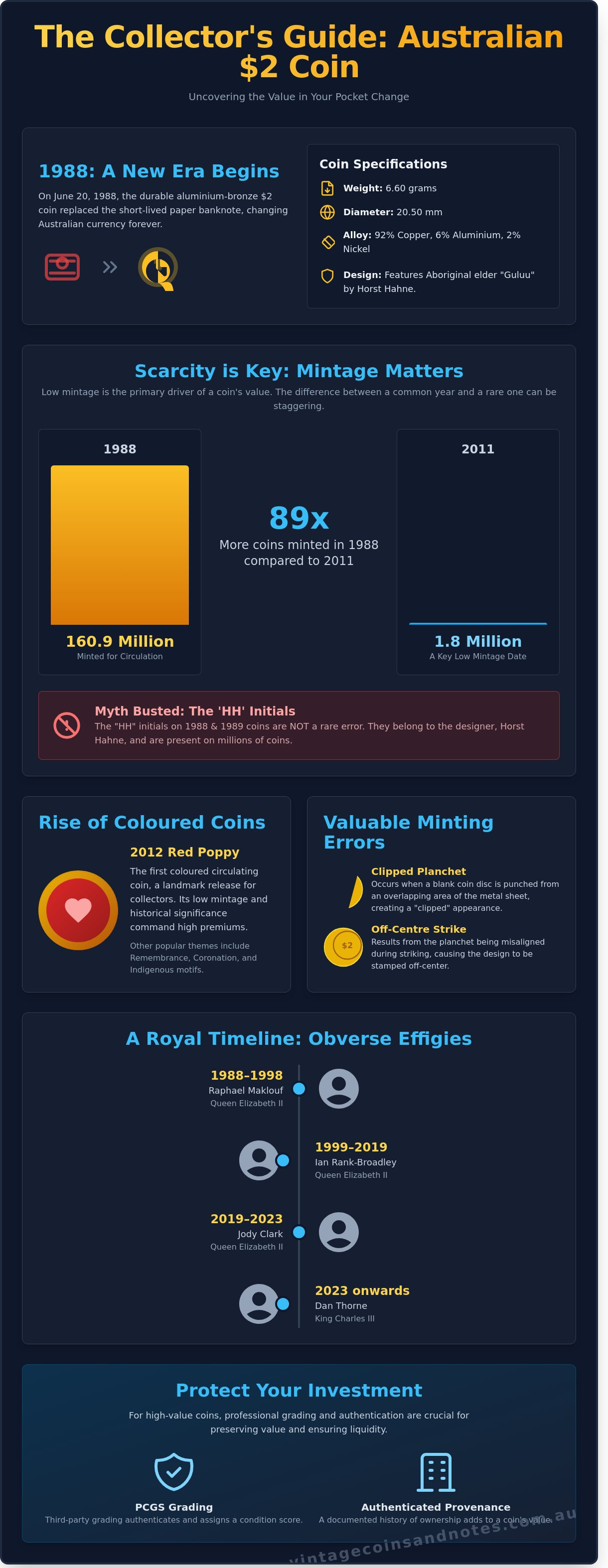
The australian two dollar coin first entered circulation on 20 June 1988. This transition replaced the green decimal banknote, which suffered from a short lifespan of roughly six months in high-velocity trade. The Royal Australian Mint (RAM) engineered a durable alternative using an aluminum-bronze alloy, consisting of 92% copper, 6% aluminum, and 2% nickel. Weighing 6.60 grams with a diameter of 20.50 millimetres, the coin's physical presence is distinct from the larger, cupro-nickel denominations. Its reverse design, crafted by Horst Hahne, depicts an Aboriginal elder against a backdrop of the Southern Cross and native grass trees. This figure is often identified as Guluu, an elder from the Gumbaynggirr people.
The Royal Australian Mint maintains the integrity of the series through rigorous quality control and limited mintage years. While the reverse design remains largely consistent, the coin's small size and thick "chunky" profile make it a favorite for those who enjoy the tactile nature of numismatics. For a deeper dive into production figures and historical context, the Australian two-dollar coin history provides a comprehensive data set for researchers. Today, the series is the primary focus for modern Australian decimal collectors because of the frequent release of low-mintage commemorative versions that circulate alongside standard issues.
The Horst Hahne (HH) Initials Mystery
Many novice collectors believe the "HH" initials found on the 1988 and 1989 issues signify a rare minting error. These initials represent the designer, Horst Hahne. In 1988, the RAM produced 160.9 million coins, many of which bear these marks. They aren't rare. A distinction exists between these standard circulation pieces and the specimen strikes found in official year sets. While a circulated 1988 coin is worth face value, a high-grade specimen or proof coin retains significant numismatic interest due to its superior finish and lower mintage. Don't let internet rumors inflate your expectations of standard pocket change.
Design Evolution and Effigy Changes
The obverse of the australian two dollar coin serves as a chronological record of the Australian monarchy. From 1988 to 1998, the Raphael Maklouf effigy dominated. In 1999, the Mint transitioned to the Ian Rank-Broadley portrait, which remained the standard for two decades. The 2019 "sixth portrait" by Jody Clark introduced a more contemporary likeness of Queen Elizabeth II. As we look toward 2026, the transition to the King Charles III effigy, designed by Dan Thorne, creates a clear boundary for specialized collectors. These shifts allow numismatists to categorize their collections into distinct eras based on the reigning monarch's profile, effectively creating sub-sets for those seeking a complete chronological run.
Key Dates and Mintage Rarities: A Scarcity Framework
In the numismatic world, the relationship between supply and value is absolute. A low mintage figure acts as a primary catalyst for future price appreciation. When the Royal Australian Mint two dollar coin data shows a significant drop in production for a specific year, those pieces become harder to locate in general circulation, leading collectors to pay a premium for high-quality examples. This scarcity framework is the foundation of a disciplined collection.
Savvy investors analyze official mintage reports to identify these anomalies. For instance, in 1988, the Mint released 160.9 million coins to facilitate the introduction of the new denomination. By contrast, the 2011 standard "Roo" australian two dollar coin saw a mintage of only 1.8 million. If you notice a year where production figures drop below 5 million units, it's a strong indicator of potential future scarcity. Understanding the difference between coins "minted for circulation" and "Non-Circulating Legal Tender" (NCLT) is equally vital. Circulation coins are intended for daily use, while NCLT items are produced specifically for the collector market and often feature superior finishes or exclusive packaging.
The 2011 Low Mintage Phenomenon
The 2011 mintage of 1.8 million remains one of the lowest for a standard design in the history of the series. Because these were intended for general use, most 2011 coins found today show heavy circulation wear. Finding a specimen in "Choice Uncirculated" or "Gem" condition is difficult. High-grade 2011 coins currently command prices well above their face value, often reaching A$50 to A$100 depending on the exact grading. The lack of pristine examples makes professional expert appraisals a necessary step for those looking to sell high-quality finds from this era.
NCLT and Mint Set Exclusives
Some coins never enter your wallet. These NCLT pieces are often found in official Royal Australian Mint sets, such as the annual Proof or Uncirculated year sets. Because these coins are never released into the wild, they maintain a higher level of preservation. Collectors often pay a significant premium for "Mint Set Only" dates that weren't released for general circulation. For a deeper look at how these exclusives fit into a broader portfolio, consult our guide on rare Australian coins to understand their long-term heritage value and investment potential within the australian two dollar coin series.
The Rise of Coloured Commemorative Two Dollar Coins
The landscape of the australian two dollar coin changed forever in 2012. That year, the Royal Australian Mint released the Red Poppy Remembrance Day coin, marking the first time colour was applied to a circulating Australian coin. With a remarkably low mintage of only 503,000, it triggered a national interest in collecting commemorative two dollar coins that continues to grow today. This release proved that a small, functional object could also serve as a canvas for national heritage, blending numismatic value with emotional resonance.
Following the success of the 2012 Red Poppy, the Mint established a consistent chronology of coloured releases. These include the 2014 Green Poppy and the 2015 Orange "Lest We Forget" designs, which solidified the series as a pillar of modern Australian collecting. Collectors often prioritize coins bearing the "C" Mintmark; these specimens are struck at the Canberra facility specifically for collector sets rather than general circulation. Because their mintage figures are strictly limited, often to 50,000 or fewer, they command a significant premium over their circulating counterparts. It's a reality that holding history in your hands becomes more exclusive when you secure these low-mintage variants.
Preservation is the primary challenge for enthusiasts in this niche. The proprietary paint technology used on the australian two dollar coin is susceptible to chipping and wear when handled. In the numismatic world, a coin with 10% paint loss is viewed with much less reverence than a pristine example. Serious investors seek coins with a high technical grade, where the enamel remains vibrant and the underlying luster is undisturbed by the friction of pocket change. Collectors don't just look for rarity; they look for the survival of the design's original integrity.
The 2013 Purple Coronation Coin
The 2013 Purple Coronation coin celebrates the 60th anniversary of the coronation of Queen Elizabeth II. Its distinctive purple concentric circles make it perhaps the most recognizable modern rarity in the country. Approximately 2.1 million were minted, yet high-grade examples are increasingly difficult to source. A circulated specimen currently trades between A$75 and A$120. In contrast, an uncirculated example in its original Royal Australian Mint card can exceed A$350 in current fair market value assessments, reflecting its status as a cornerstone of the decimal era.
Olympic and Commonwealth Games Series
The 2016 Olympic series introduced five different coloured rings, distributed primarily through a partnership with Woolworths. This strategy brought numismatics to a non-traditional audience, including children and casual shoppers. The 2020 Tokyo sets, actually released in 2021 due to global delays, followed a similar pattern with distinct designs for different sporting disciplines. These sets are essential for completing a modern collection. While their mintages are higher, reaching up to 2 million per design, the themed nature of sporting commemoratives ensures they remain a stable entry point for the secondary market.
Identifying Valuable Error Coins and Minting Varieties
The Royal Australian Mint maintains rigorous quality controls, yet the sheer volume of production occasionally allows a "mint error" to escape into circulation. For the dedicated collector, these imperfections represent a unique moment where the mechanical process failed, creating a one of a kind specimen. The allure lies in the rarity; a standard australian two dollar coin is a tool of commerce, but an error coin is a historical artifact of a manufacturing anomaly. Perfection is the goal for the Mint, but for the investor, the deviation is the prize.
Common $2 errors include clipped planchets, which occur when the blanking press cuts into an already punched area of the metal strip. This results in a coin with a crescent shaped "bite" taken out of the edge. Oil strikes, or filled die errors, happen when machinery lubricant builds up in the crevices of the die, preventing the design from fully forming on the blank. This often leaves the coin looking "mushy" or missing specific letters in the Queen's title or the date. In contrast, off-centre strikes occur when the planchet isn't properly seated in the coining chamber, resulting in a design that's partially missing.
The "Bullseye" error is a term often used to describe a significant misaligned die. On an australian two dollar coin, this presents as the design being struck off-centre on one side while the other side remains relatively aligned. This creates a wide, blank crescent on one edge of the rim. Distinguishing these from Post-Mint Damage (PMD) is vital for any serious buyer. Genuine errors show microscopic "flow lines" in the metal where the alloy was forced into the die under immense pressure. PMD, such as scratches from a sorting machine or chemical corrosion, lacks these structural markers and generally decreases the coin's value.
The 2010 "Tall Poppy" and Other Varieties
Varieties differ from errors because they're caused by intentional or semi-permanent changes to the die itself. The 2010 "Tall Poppy" Remembrance Day coin is a prime example where collectors hunt for subtle die variations. Finding these requires high-magnification inspection to identify doubled dies or small "cuds" where a piece of the die has chipped away. For those interested in how these variations impact market value, our 1966 Australian fifty cent coin guide provides an excellent parallel for understanding variety hunting.
Mules and Double-Sided Errors
A "Mule" is a coin struck with mismatched dies, such as an obverse from one denomination and a reverse from another. While the 2000 $1/10c mule is the most famous Australian example, collectors constantly scan the $2 series for similar accidental pairings. These items are exceptionally rare and frequently faked. Because of their high market value, any suspected mule requires professional authentication. We recommend seeking an expert numismatic appraisal to confirm the provenance and grade of any high-value error before attempting a sale.
Professional Valuation and Investment Strategy
Transitioning from a hobbyist to a serious numismatic investor requires a fundamental shift in perspective. You're no longer just filling holes in a folder; you're acquiring tangible assets with specific market trajectories. In the 2026 market, the australian two dollar coin has matured into a legitimate asset class. Success in this space depends on your ability to distinguish between a "nice coin" and an investment-grade specimen that will maintain liquidity during market fluctuations.
Success as an investor relies on two pillars: provenance and condition. Provenance provides a documented history of ownership, which is vital for high-value errors or low-mintage releases like the 2012 Red Poppy. Condition, however, remains the primary driver of price. A single point difference on a grading scale can represent a value swing of thousands of dollars.
The Importance of PCGS Grading for Decimals
The Professional Coin Grading Service (PCGS) has revolutionised how we trade Australian decimals. By using a universal 70-point scale, PCGS provides a level of standardisation that raw, unslabbed coins simply cannot match. This third-party guarantee eliminates disputes over "About Uncirculated" versus "Choice Uncirculated" status, making your collection instantly more liquid on the global stage. You can learn more about this process in our guide to investing in PCGS graded coins.
Standardisation is particularly crucial for the australian two dollar coin series due to the high volume of "noodled" coins in the market. During the 2025 auction season, specimens graded at MS68 or MS69 consistently fetched prices 40% higher than their lower-graded counterparts. A MS69 grade represents a near-perfect strike, a rarity for coins produced at high speeds by the Royal Australian Mint. These elite grades are the "blue chips" of the numismatic world.
Securing Your Collection’s Future
Preserving the physical integrity of your investment is a non-negotiable task. Many collectors inadvertently damage their holdings by using cheap plastic flips containing PVC. Over time, PVC breaks down and creates an acidic green residue that permanently etches the coin's surface, destroying its numismatic value. We recommend using archival-quality, PVC-free materials or keeping your assets in sonically sealed PCGS slabs to prevent environmental toning and physical wear.
Professional valuations are also essential for administrative and legal reasons. If you hold your collection within a Self-Managed Super Fund (SMSF), Australian Taxation Office regulations require regular, independent valuations to ensure compliance. Similarly, insurance providers require documented appraisals to provide adequate coverage against theft or fire. Vintage Coins & Notes provides the meticulous, data-driven appraisals required for these high-stakes scenarios, ensuring your legacy is protected. Book a private appointment for a professional valuation to receive an expert assessment of your portfolio's current fair market value.
Charting the Future of Your Collection
Navigating the complexities of the australian two dollar coin market requires a balance of historical knowledge and technical precision. Since the transition from paper notes in 1988, this denomination has evolved from a circulating workhorse into a canvas for national storytelling. Collectors who focus on low mintage figures, such as the 5.9 million coins struck in 1991, or the technical nuances of the 2012 Red Poppy, are best positioned for long-term growth. Identifying genuine minting errors or securing high-grade specimens remains the most reliable strategy for building a portfolio with enduring value in 2026.
Determining the fair market value of your holdings is a critical step in this journey. Our family-owned and operated business brings over 45 years of numismatic expertise to every assessment. We provide expert PCGS grading advice to ensure your rare varieties receive the recognition they deserve. Whether you've held a collection for decades or recently discovered a unique error, professional insight ensures you make informed decisions about your assets. Request a professional valuation for your coin collection today to understand the current worth of your heritage. It's a rewarding path that connects you directly to Australia's tangible history.
Frequently Asked Questions
Which Australian $2 coin is the rarest currently in circulation?
The 2012 Red Poppy remains the rarest Australian two dollar coin found in general circulation, with a total mintage of just 503,000 pieces. While the 2011 issue has a mintage of 1.8 million, the Red Poppy's status as the first coloured circulating coin makes it exceptionally difficult to find in daily change. Collectors also keep a close watch for the 2015 "Lest We Forget" orange coin, which had a mintage of 1.46 million.
Are the 1988 $2 coins with the HH initials actually valuable?
The 1988 $2 coins featuring the "HH" initials aren't considered rare or highly valuable, as they represent a standard part of the initial 160.9 million mintage. These initials belong to the designer, Horst Hahne, and appear on the majority of coins from that inaugural year. While some online sellers list them at high prices, their fair market value for a circulated specimen remains exactly A$2. Only high-grade, uncirculated examples from 1988 command a small premium for specialist collectors.
What is the most valuable coloured $2 coin to look for?
The 2012 Red Poppy is the most valuable coloured australian two dollar coin for collectors, particularly when found in uncirculated condition. By 2026, a pristine specimen can command prices exceeding A$450, while even circulated examples often fetch over A$150. This coin’s value stems from its historic status as the first coloured coin released into Australian circulation and its remarkably low production volume of 503,000. It remains a cornerstone of any serious numismatic portfolio.
How can I tell if my $2 coin is a genuine mint error?
You can identify a genuine mint error by looking for specific mechanical irregularities like off-centre strikes, clipped planchets, or the famous 2007 "Double Head" error. A true error occurs during the Royal Australian Mint’s striking process and creates a physical deviation from the standard design. We recommend using a 10x magnification loupe to inspect the rim and surface for structural anomalies. If you suspect an error, seek an expert appraisal to distinguish a valuable mint mistake from post-mint damage.
Is it worth getting my $2 coins graded by PCGS?
Grading your coins through PCGS is worthwhile if the item is a rare date or appears to be in "Choice Uncirculated" condition or better. Professional grading provides a third-party guarantee of authenticity and a specific numerical grade on the 70-point Sheldon scale. This certification often increases the liquidity and resale value of high-tier coins like the 2012 Red Poppy. For common circulated coins, the A$40 to A$60 grading fee usually exceeds the coin's actual market value.
How much is a 2012 Red Poppy $2 coin worth in 2026?
In 2026, a 2012 Red Poppy australian two dollar coin is valued between A$150 for circulated examples and upwards of A$450 for MS65 graded specimens. These figures reflect a steady appreciation since its release, driven by its status as a foundational piece of Australian numismatic history. Market demand remains high because many of the original 503,000 coins have been withdrawn from circulation by collectors. Prices fluctuate based on the specific eye appeal and the absence of surface marks or bag marks.
What should I do if I find a $2 coin with a "C" mintmark?
If you find a $2 coin with a "C" mintmark, you've found a specimen struck specifically for collectors at the Royal Australian Mint in Canberra. These coins aren't intended for general circulation and are usually sold in official presentation folders. Finding one in your change means someone has likely spent a collector's item by accident. These "C" mintmark issues are highly sought after and typically hold a higher premium than their non-mintmarked circulating counterparts.
Does cleaning a $2 coin reduce its numismatic value?
Cleaning an Australian two dollar coin will almost always reduce its numismatic value by damaging the original mint lustre. Harsh chemicals or abrasive cloths create hairlines, which are microscopic scratches that professional graders like PCGS easily detect. A cleaned coin is often downgraded to "Genuine; Cleaned," which can slash its market price by 50% or more. If your coin has dirt or debris, it's safer to leave it in its original state to preserve its historical integrity.
A single 7.98-gram disc of 22-carat gold struck at the Melbourne Mint in 1901 carries more weight in a modern portfolio than almost any digital asset. While many investors focus solely on fluctuating spot prices, the end…
Holding a 1930 Australian Penny isn't just about owning a piece of copper. It's about possessing a tangible relic of the Great Depression that, in high grades, has seen its value climb toward A$30,000 at recent auctions.…
A raw coin is merely a historical artifact; a PCGS slabbed specimen is a globally recognized financial instrument. For the serious Australian investor, pcgs graded coins represent the gold standard in risk mitigation, re…