Gold Sovereigns: The Essential Guide for Australian Investors and Collectors (2026)
April 04, 2026
A single 7.98-gram disc of 22-carat gold struck at the Melbourne Mint in 1901 carries more weight in a modern portfolio than almost any digital asset. While many investors focus solely on fluctuating spot prices, the enduring legacy of gold sovereigns offers a unique security that transcends simple bullion. You likely understand the importance of diversifying into tangible assets, yet the confusion between bullion premiums and numismatic value often creates a hesitation that stalls your investment progress.
We've designed this guide to remove that uncertainty for the 2026 Australian market. You'll discover why these coins remain the gold standard for local portfolios by blending historical heritage with high-purity security. We'll walk through the process of identifying authentic Perth and Sydney mint marks, explain how to calculate fair market value using current A$ data, and provide a clear framework for building a secure investment portfolio that puts history in your hands.
Key Takeaways
Understand the 500-year legacy of the 22-carat gold standard, a cornerstone of numismatic history that offers both tangible security and historical prestige.
Evaluate the strategic benefits of gold sovereigns over traditional bullion bars, focusing on their exceptional liquidity and portability within the Australian market.
Master the nuances between bullion, proof, and graded finishes to ensure your acquisitions align with your specific investment or collecting objectives.
Learn to identify rare Australian-minted specimens by locating the distinct Sydney, Melbourne, or Perth mint marks on the reverse of the coin.
Gain professional insights into managing your portfolio, from conducting due diligence on reputable dealers to obtaining expert valuations for heritage collections.
What are Gold Sovereigns and Why Do They Dominate the Market?
The gold sovereign stands as a pinnacle of numismatic history, often described as the 'chief coin of the world'. Its legacy spans over 500 years, originating in 1489 under King Henry VII. However, the gold sovereigns we recognise today as the global investment standard were established during the Great Recoinage of 1817. This modern iteration introduced the 22-carat gold standard and the iconic St George and the Dragon design by Benedetto Pistrucci, a motif that remains a hallmark of trust and prestige in the Australian market today.
Investors gravitate toward these coins because they offer a unique blend of historical significance and high liquidity. In the 19th century, they functioned as the de facto global reserve currency, accepted from the counting houses of London to the goldfields of Ballarat. Today, they remain a staple for those seeking to protect wealth. While 1oz bars are common, sovereigns provide a fractional entry point that's easier to trade in smaller increments. For Australian collectors, the market distinguishes between 'Type' collecting, where one seeks a single representative example of a design, and date-specific investing, which targets rare mintages or specific historical years like the 1920 Sydney Mint issue.
The Anatomy of a Sovereign: Purity and Weight
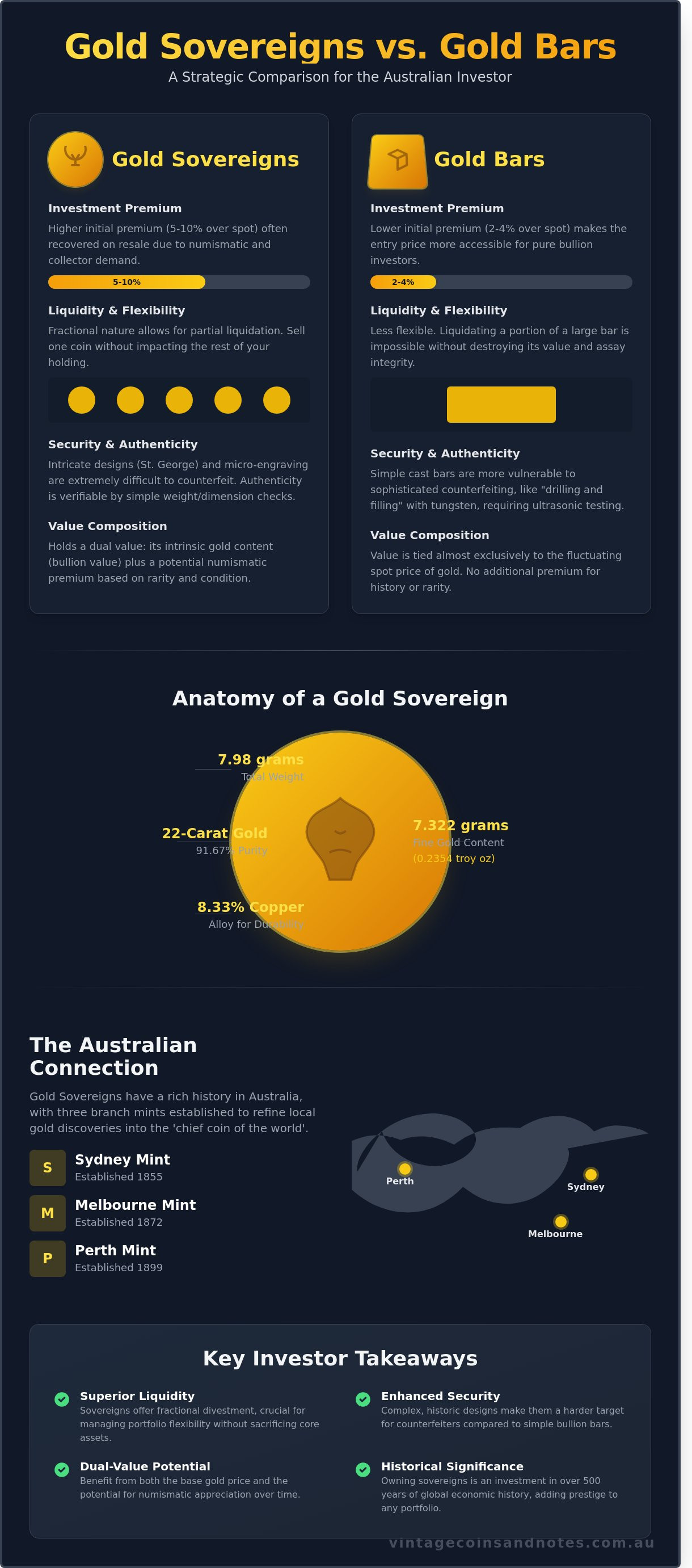
Precision is the foundation of the sovereign’s enduring value. Each full sovereign is struck with a total weight of 7.98 grams. Because it's minted in 22-carat gold, also known as 91.67% purity, the actual fine gold content is exactly 7.322 grams, or 0.2354 troy ounces. The remaining 8.33% of the alloy is typically copper, which provides the 'circulation strength' necessary to resist scratches and wear. This durability ensures that even coins from the Victorian era often retain their investment-grade appeal. The fractional size makes these coins significantly more liquid than 1oz bars, as they allow for more flexible liquidation during periods of market volatility.
A Brief History of the 'Chief Coin'
The history of the Gold Sovereign reflects the expansion of the British Empire and its economic might. After its 1817 relaunch, the coin became the engine of international trade. By the late 1800s, the Royal Mint established branch mints in Sydney (1855), Melbourne (1872), and Perth (1899) to process local gold discoveries. This Australian connection is vital for local investors. The transition from circulating currency to a global investment standard occurred after 1914, as nations moved away from the gold standard. Despite no longer being found in daily change, the sovereign’s specifications haven't changed in over 200 years, providing a level of physical consistency that few other assets can match.
Comparing Sovereigns to Gold Bars: Which is the Smarter Buy?
Investors often weigh the lower entry price of cast bars against the higher manufacturing premiums of gold sovereigns. While a 1oz gold bar might carry a premium of 2% to 4% over the current spot price, a sovereign typically commands 5% to 10%. This extra cost covers the intricate striking process and historical prestige. However, the premium isn't a lost expense. It's often recovered at the point of sale because secondary market demand for coins remains consistently higher than for generic bullion bars.
The complex relief of Benedetto Pistrucci's "St George and the Dragon" design serves as a built-in security feature. Modern issues from The Royal Mint include micro-engraved details that are nearly impossible for counterfeiters to replicate with precision. In contrast, simple cast bars are more vulnerable to "drilling and filling" with tungsten, a risk that requires expensive ultrasonic testing to mitigate. With a sovereign, a simple weight and dimension check usually confirms authenticity.
The Fractional Advantage for Investors
Holding ten sovereigns provides significantly more flexibility than owning a single 2.5oz gold bar. If you need A$1,300 for an urgent expense in 2026, you can sell one coin. You can't slice a corner off a large bar without destroying its assay integrity and market value. This ability to partially liquidate a portfolio protects your core position during market volatility. Australian demand for fractional gold rose by 14% in the 2024-2025 financial year, as buyers sought portable wealth that's easily traded in small increments.
Intrinsic Value vs. Numismatic Premium
Every sovereign contains exactly 7.322 grams of pure gold, which establishes its "Spot Value" or financial floor. Beyond this, the numismatic premium is the value added by rarity and demand beyond the metal content. A common 1911 London Mint sovereign might trade close to the gold price, but a 1920-S (Sydney Mint) sovereign carries a massive premium due to its extreme rarity and historical provenance.
Historical coins can decouple from the gold price entirely. If the spot gold price drops by 3%, a rare date sovereign might still appreciate if collector interest spikes or mintage data reveals a lower survival rate than previously thought. For those seeking a professional expert appraisal of their current holdings, understanding this distinction between metal weight and historical scarcity is the first step toward a smarter investment strategy. The market for gold sovereigns remains one of the few areas where an investor can benefit from both commodity price increases and collector-driven value spikes.
Bullion vs. Proof vs. Graded Sovereigns: Navigating the Options
Selecting the right type of gold sovereigns depends entirely on your objectives, whether you seek a liquid hedge against inflation or a numismatic masterpiece. Bullion sovereigns are the standard choice for high-volume investors. These coins trade at a narrow premium over the live gold spot price, typically between 4% and 8% depending on the quantity purchased. Because they were minted in the millions for general circulation, their value is primarily tied to their 7.322 grams of fine gold content. They offer a practical way to accumulate physical wealth without paying for historical rarity.
Proof sovereigns represent the pinnacle of the minting art. These coins are struck at least twice using specially polished dies, resulting in a high-luster finish where the frosted design stands out against a mirror-like field. Mintages for proof issues are strictly limited, often to just a few thousand pieces globally. This scarcity ensures that their market value remains decoupled from the daily fluctuations of gold prices. For a deeper understanding of how these specifications evolved, the History of the Gold Sovereign provides essential context on the transition from a circulating currency to a collector's specimen.
The Role of PCGS in Sovereign Investing
Third-party grading through the Professional Coin Grading Service (PCGS) has transformed the Australian market by eliminating disputes over a coin's state of preservation. Because 22-carat gold is relatively soft, even minor handling can cause "bag marks" or surface hairlines that diminish value. A PCGS "slab" provides a tamper-evident, sonically sealed environment that protects the physical integrity of the coin. In the secondary market, a high grade such as MS65 (Mint State 65) can command a price 50% to 100% higher than an MS62 example of the same date. This level of certainty is a cornerstone of a sophisticated pcgs graded coins strategy, ensuring that your investment is liquid and universally recognised by dealers across the globe.
When to Buy Raw vs. When to Buy Graded
Buying uncertified or "raw" coins from private sellers involves a risk profile that many serious investors prefer to avoid. Counterfeits and "doctored" coins, which have been chemically cleaned to appear brighter, are common in the unregulated market. You should generally only buy raw coins when they are common-date bullion pieces from a trusted dealer. For any sovereign dated before 1900, or specific Australian mint marks like the rare 1920 Sydney, professional grading is non-negotiable. A balanced portfolio often consists of 70% bullion sovereigns for weight and 30% graded sovereigns for potential numismatic growth. This approach allows you to benefit from the rising price of gold while holding assets that appreciate due to their historical significance and verified condition.
The Australian Connection: Sydney, Melbourne, and Perth Mints
Australia's gold rush history is inseparable from the story of gold sovereigns. The discovery of gold in New South Wales and Victoria in 1851 created an immediate need for local minting facilities to avoid the dangerous and slow process of shipping raw bullion to London. This demand led to the establishment of the Sydney Mint in 1855, followed by Melbourne in 1872 and Perth in 1899. These branch mints produced hundreds of millions of coins over seven decades, yet they remain distinct from British-struck pieces due to their unique provenance and local heritage. For the modern collector, holding an Australian-struck sovereign means holding history in your hands; it's a tangible connection to the rugged prosperity of the colonial era.
Identifying Australian Mint Marks
To determine if your gold sovereigns originated in Australia, you must examine the reverse side of the coin. On the classic St George and the Dragon design, a tiny letter is struck just above the date, resting on the ground line beneath the horse’s rear hooves. This mark is often small enough to require a magnifying loupe for clear identification.
The Sydney Mint (S): Operating from 1855 to 1926, Sydney was the first branch mint outside of London. Between 1855 and 1870, it produced a unique design featuring a wreath and the word "Australia" instead of the standard St George motif. These are highly prized for their distinct aesthetic.
The Melbourne Mint (M): Production began in 1872. Melbourne was prolific, often striking millions of coins annually to keep up with the Victorian goldfields' output.
The Perth Mint (P): Opened in 1899, the Perth Mint was established specifically to process the massive yields from the Western Australian gold rushes. It continued striking sovereigns until 1931.
Key Rarities for the Australian Collector
While many Australian sovereigns trade at prices close to their gold content, specific dates command immense numismatic premiums. The 1920 Sydney Mint (1920-S) sovereign is the "holy grail" of the series. With only a handful of confirmed examples in existence, a high-grade specimen can command a value exceeding A$1,000,000 at auction. Other significant dates include the 1921-M and the 1923-M, which frequently see valuations above A$50,000 depending on their condition and provenance.
International collectors seek out Australian-minted sovereigns because these branch mints often maintained exceptional striking standards. The sharp detail on a Perth or Melbourne strike is frequently superior to contemporary London issues. You can explore our rare australian coins guide to see how these gold pieces fit into the broader narrative of our national numismatic heritage. Whether you are an investor looking for liquidity or a collector chasing a rare date, the Australian branch mint series offers a wealth of opportunity.
How to Safely Buy and Manage Your Gold Sovereign Portfolio
Building a robust portfolio of gold sovereigns requires more than just capital; it demands a partnership with a dealer who possesses deep historical perspective. You should prioritize firms with at least 45 years of industry experience. This longevity ensures they've navigated multiple market cycles and possess the technical skills to distinguish between a genuine mint state coin and a clever counterfeit. For those who have inherited a collection, the priority shifts to establishing a clear inventory. An inherited estate often contains a mix of bullion-grade coins and numismatic rarities. You need a detailed assessment to ensure no "key dates" are overlooked before you consider a sale or consignment.
Storage is your next hurdle. Physical wealth is vulnerable to both theft and the Australian climate. High humidity in coastal regions can lead to "red spots" or copper toning on 22-carat gold. Professional third-party vaulting remains the gold standard for security. If you choose to store items at home, a safe rated for TDR (Torch and Drill Resistance) is essential. Your insurance policy must specifically list numismatic items. Standard home and contents policies often cap payouts for "curios" or "valuables" at a few thousand dollars, which won't cover a significant collection of gold sovereigns.
Sovereigns and Self-Managed Super Funds (SMSF)
The Australian Taxation Office (ATO) enforces strict "collectable and personal use asset" rules under the Superannuation Industry (Supervision) Act 1993. You can't store sovereigns in your private residence if they're owned by your SMSF. They must be held in independent, secure storage. You'll also need a signed storage agreement and an annual insurance policy in the fund's name. Many trustees prefer graded sovereigns from services like PCGS or NGC. These provide an objective third-party grade that simplifies the mandatory annual audit and ensures transparency for the fund's valuation.
Getting Started with a Professional Appraisal
Understanding the value of your holdings is the first step toward a successful exit strategy. A "buy price" represents what a dealer pays to acquire stock, typically based on the current spot price plus a small premium for condition. An "insurance valuation" is higher, reflecting the cost to replace a specific coin at retail in the current market. We provide clarity through our professional assessment services. If you're ready to transition your portfolio, Contact David Jobson for an expert appraisal of your gold sovereigns. We offer a no-obligation valuation for those looking to sell or consign, ensuring you receive fair market value for your pieces of history.
Securing Your Legacy with Australian Gold
Selecting gold sovereigns for your portfolio represents more than just a hedge against inflation; it's an investment in a tangible heritage that has maintained its value for over five centuries. These coins offer a level of liquidity and historical significance that standard bullion bars often lack. By focusing on the unique mintage histories of the Sydney, Melbourne, and Perth mints, you're positioning yourself within a storied tradition of Australian wealth. It's vital to rely on the grading standards of a professional PCGS authorized dealer to ensure the authenticity and condition of every piece you acquire. Quality endures.
Since 1981, our family-owned team has provided over 45 years of numismatic expertise to help collectors navigate the complexities of the market. We understand that every transaction is about building long-term credibility and securing your financial future. Whether you're looking for an uncirculated specimen or a rare historical date, we're here to provide the steady, expert guidance you need to grow your collection with confidence. Secure Your Investment: Browse Our Authentic Gold Sovereigns Today
We invite you to explore the lasting stability of these iconic coins and enjoy the quiet satisfaction of holding history in your hands.
Frequently Asked Questions
Are gold sovereigns a good investment in 2026?
Gold sovereigns remain a highly liquid and reliable investment in 2026 because they bridge the gap between bullion value and numismatic rarity. They provide a portable store of wealth that historically tracks with the spot price of gold, which has maintained a steady upward trajectory over the last decade. Investors often prefer these coins for their 22-carat durability and the fact that every major dealer across the globe recognizes them instantly.
How much gold is actually in a full sovereign coin?
A standard full sovereign contains exactly 7.322 grams, or 0.2354 troy ounces, of pure gold. While the total weight of the coin is 7.988 grams, it's struck in 22-carat gold to ensure the piece can withstand handling without excessive wear. This specific alloy consists of 91.67% gold and 8.33% copper, a standard established by the British Royal Mint in 1817 that remains the benchmark for gold sovereigns today.
What is the difference between a full sovereign and a half sovereign?
The primary difference lies in the weight and gold content; a half sovereign contains exactly 50% of the gold found in a full sovereign. A half sovereign weighs 3.99 grams and contains 3.66 grams of fine gold, whereas the full version weighs 7.98 grams. While both share the iconic St. George and the Dragon design, the full sovereign has a diameter of 22.05mm compared to the 19.30mm of the half sovereign.
Which Australian gold sovereigns are the most valuable?
The 1920 Sydney Mint sovereign is the most valuable Australian issue and can command prices exceeding A$1,000,000 in high grades. Other high-value pieces include the 1855 and 1856 Sydney Mint Type I sovereigns, which were the first of their kind struck in Australia. Collectors also seek out low-mintage years from the Perth and Melbourne Mints, where specific dates like the 1899 Perth or 1921 Melbourne often carry premiums of 25% to 50% over their metal value.
Do I have to pay GST on gold sovereigns in Australia?
You don't have to pay GST on gold sovereigns in Australia because they're classified as investment grade precious metals under Australian Taxation Office rulings. To qualify for this exemption, a gold coin must be at least 99.5% pure or be a recognized trade coin like the sovereign. This tax-free status applies to both full and half sovereigns, making them a cost-effective choice for local investors looking to maximize their physical gold holdings without a 10% tax burden.
How can I tell if my gold sovereign is real or a counterfeit?
You can verify a sovereign's authenticity by checking its precise weight of 7.98 grams and diameter of 22.05mm using digital calipers. Counterfeits often miss these exact specifications or lack the sharp, defined denticles around the coin's edge. Professional dealers use X-ray fluorescence (XRF) scanners to confirm the 22-carat gold composition, as many fakes are made of gold-plated lead or inferior alloys that lack the characteristic ring of genuine gold sovereigns when gently tapped.
Should I clean my gold sovereigns before having them valued?
You should never clean your gold sovereigns as this causes irreversible damage to the coin's surface and reduces its market value. Even a soft cloth can leave microscopic scratches, known as hairlines, which professional graders instantly recognize. A coin with its original mint luster or a natural aged patina is far more desirable to collectors. Cleaning can strip away this history and potentially lower a rare coin's appraisal by 30% or more.
Where is the best place to sell gold sovereigns for a fair price?
The best place to sell is through a specialized numismatic dealer who understands both the bullion price and the historical premium of your coins. Unlike general pawn shops that may only offer the base melt value, an expert dealer provides a fair market value based on the coin's rarity and condition. We recommend seeking an expert appraisal that considers the specific mint mark and date to ensure you aren't leaving money on the table during an estate liquidation.
Holding a 1930 Australian Penny isn't just about owning a piece of copper. It's about possessing a tangible relic of the Great Depression that, in high grades, has seen its value climb toward A$30,000 at recent auctions.…
A raw coin is merely a historical artifact; a PCGS slabbed specimen is a globally recognized financial instrument. For the serious Australian investor, pcgs graded coins represent the gold standard in risk mitigation, re…
Did you know that a 1930 penny in "Fine" condition recently commanded a price of A$59,415 at a public auction? This represents a staggering return for a coin that was never officially meant to be issued for circulation. …