Australian 1 Dollar Note: Value, History, and Collector’s Guide for 2026
March 30, 2026
Could a crisp, green slip of paper from 1966 actually be worth 500 times its original face value in today's market? Many Australians hold onto a vintage australian 1 dollar note as a piece of tangible heritage, yet few realize that specific printing variations can turn a simple keepsake into a high-value asset. You've probably felt that familiar hesitation when looking at a collection, wondering if a dealer's offer reflects the true fair market value or if a rare signature combination is hiding in plain sight. It's common to feel overwhelmed by the subtle differences between a common issue and a rare specimen.
This guide clarifies the complexities of numismatic grading so you can distinguish between a standard circulated note and a rare, investment-grade specimen. We'll reveal the specific 2026 valuations for key varieties, including the sought-after Coombs/Wilson and Johnston/Stone signatures that collectors currently prize. You'll also learn which first-prefix serial numbers from the 1984 final print run command the highest premiums. By the end of this article, you'll know exactly how to assess your collection's provenance and where to secure a professional, no-obligation appraisal to ensure your history is valued correctly.
Key Takeaways
Trace the heritage of the australian 1 dollar note from its 1966 introduction to its status as a foundational piece of modern Australian numismatics.
Identify which specific signature combinations, such as the early Coombs/Wilson era, hold the greatest potential for significant financial appreciation.
Uncover the secrets of rare "Star notes" and printing errors that can transform a standard paper note into an exceptionally scarce collector's item.
Learn the critical importance of condition and grading, understanding how a single corner fold can dramatically impact the fair market value of your collection.
Explore how professional valuations can assist in securing your legacy through accurate appraisals for insurance, probate, and SMSF portfolios.
The Legacy of the Australian 1 Dollar Note
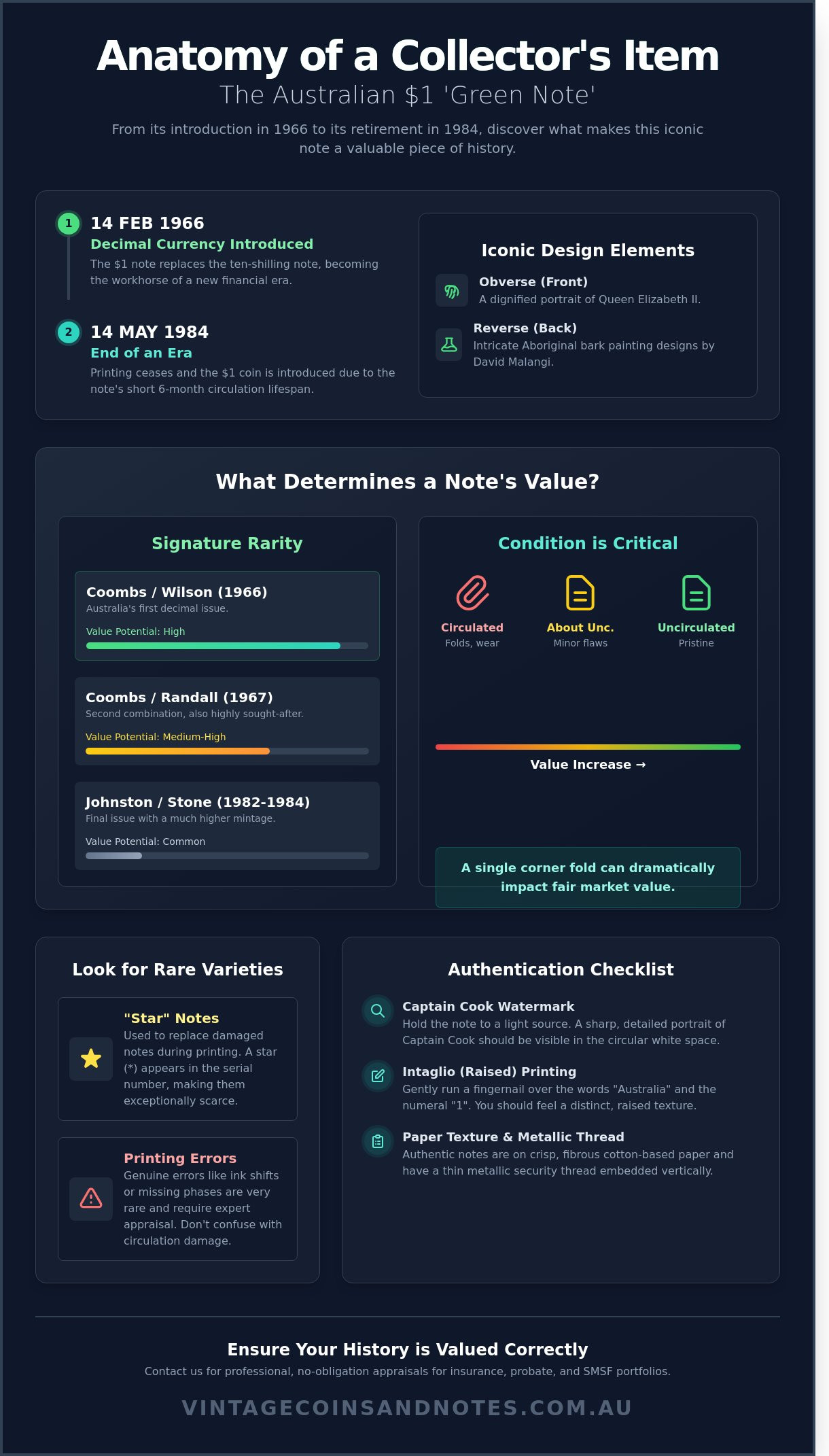
The transition to decimal currency on 14 February 1966 marked a pivotal moment in our nation's financial heritage. On this day, known as C-Day, the ten-shilling note was retired to make way for the new decimal system. The australian 1 dollar note emerged as the workhorse of this new era, bridgeing the gap between the old imperial system and a modern economy. Featuring a dignified portrait of Queen Elizabeth II on the obverse and intricate Aboriginal bark painting designs by David Malangi on the reverse, the note was a masterpiece of mid-century design. Holding history in your hands becomes a literal experience when examining these paper relics, as they represent the first time Indigenous Australian art was featured on the national currency.
From Paper to Coin: A Brief History
By the early 1980s, the Reserve Bank of Australia faced a logistical challenge. The average lifespan of a paper australian 1 dollar note was only about six months before it became too worn for circulation. This high turnover, combined with the rising popularity of high-value vending machines, necessitated a more durable solution. On 14 May 1984, the gold-coloured 1 dollar coin was introduced, and the printing of paper notes ceased. This shift wasn't just practical; it had a profound cultural impact. Known affectionately as "The Green Note," its withdrawal triggered an immediate wave of nostalgia. Collectors began hoarding crisp, uncirculated bundles, effectively creating a robust numismatic market overnight. Today, these notes are viewed as essential cornerstones for any serious collection of Australian decimal currency.
Identifying Genuine Paper Currency
When assessing the authenticity and provenance of a Australian one-dollar note, several security features are paramount. The most recognizable is the Captain Cook watermark, which is visible when the note is held against a light source. It should appear sharp and detailed within the white circular space on the left side of the obverse. Additionally, a thin metallic thread is embedded vertically through the paper, a feature that was advanced for its time.
Intaglio Printing: Genuine notes utilize raised ink printing. You can feel the distinct texture on the words "Australia" and the numeral "1" by lightly running a fingernail across the surface.
Paper Texture: Authentic notes were printed on a specific cotton-based paper that feels crisp and fibrous, unlike the smooth or waxy feel of modern counterfeits or photocopies.
Misprint Myths: Many hobbyists mistake heavy circulation folds or chemical fading for rare printing errors. True errors, such as significant registration shifts or missing ink phases, are exceptionally rare and require expert appraisal to verify their fair market value.
As we look toward the 2026 market, the condition remains the most critical factor in valuation. A note that has been folded or "washed" loses a significant portion of its investment potential compared to a flat, pristine specimen. If you've discovered a collection of these historic notes in an estate, we invite you to contact us for a professional assessment to ensure you understand their true historical and financial significance.
Key Value Drivers: Signatures and Serial Numbers
The market for the australian 1 dollar note relies on a hierarchy of technical details that separate common currency from investment-grade rarities. While millions of these notes circulated daily between 1966 and 1984, their current appraisal depends heavily on the specific individuals who signed the printing plate. The combination of the Governor of the Reserve Bank and the Secretary to the Treasury provides a definitive timestamp and mintage context for every issue. Beyond these names, the serial number and the physical state of the paper dictate the final market price.
The Rarity of Signature Combinations
Collectors view the Coombs/Wilson (1966) and Coombs/Randall (1967) combinations as the foundation of a sophisticated collection. These represent Australia's first decimal banknotes, marking the historic transition from the pound to the dollar. You'll find these signatures located at the bottom of the note; the Governor’s signature sits on the right, while the Secretary to the Treasury is on the left. In contrast, later issues like the Johnston/Stone combination from 1982 to 1984 had much higher mintage figures, often exceeding 200 million notes per year. This high volume makes them common in circulated condition, though they still hold value if they've never seen the inside of a wallet. If you aren't sure which combination you hold, an expert appraisal can clarify the specific rarity of your item.
Serial Number Secrets: What to Look For
The serial number is the unique fingerprint of your australian 1 dollar note. Certain sequences command significant premiums due to their scarcity or visual appeal to "fancy number" specialists. Look for these specific markers:
First Prefix (AAA): These were the very first notes printed in 1966. An uncirculated AAA note can fetch ten times the price of a standard prefix from the same year.
Last Prefix (DPS): The final print run in 1984 used the DPS prefix. These are highly sought after because they represent the end of the paper dollar era before the gold-coloured coin took over.
Radar Numbers: These numbers read the same forwards and backwards, such as 248842. They're a favorite among numismatists for their symmetry.
Solid Numbers: A sequence of identical digits, like 555555, is exceptionally rare. Finding one in any condition is a significant discovery.
Condition acts as the ultimate multiplier for these values. A Coombs/Wilson note in "Fine" condition might sell for A$25, but the same note in "Uncirculated" grade, showing no signs of handling, can easily exceed A$450. Even a rare prefix loses its investment appeal if the paper is limp or heavily creased. Professional grading ensures that these physical attributes are recorded accurately for the 2026 market, protecting the heritage of the note for future generations.
Rare Varieties: Star Notes and Error Notes
While the standard australian 1 dollar note is a familiar piece of numismatic history, specific varieties exist that represent the pinnacle of paper currency collecting. These rarities generally fall into two categories: replacement notes and printing errors. For a serious collector, finding a note that escaped the usual quality control measures at Note Printing Australia is like uncovering a hidden treasure. These items don't just tell a story of currency; they represent a specific, unrepeatable moment in the industrial printing process.
The Hunt for the Star Note
Star notes are among the most sought-after items in the Australian decimal series. Between 1966 and 1972, the Reserve Bank used these notes to replace sheets that were damaged or misprinted during the production run. You'll recognize them by the distinctive '*' suffix at the end of the serial number. This system was eventually abandoned, as the bank transitioned to using 'Z' prefix serial numbers for replacements in later denominations. This makes the $1 star note a finite resource with a fixed supply.
The market performance for these notes has remained remarkably resilient. Auction results from late 2025 show that a Coombs/Randall $1 star note in Uncirculated condition can fetch upwards of A$5,500. When you're assessing a potential star note, it's vital to verify the "star" symbol's authenticity. Fraudulent sellers sometimes attempt to add a star to a standard note, but genuine examples show consistent ink bleed and typeface alignment that matches the rest of the serial number. It's a matter of holding history in your hands while maintaining a sharp eye for detail.
Identifying Valuable Printing Errors
Errors occur when the mechanical process of printing, folding, or cutting goes awry. The Reserve Bank of Australia's history of the $1 note highlights the complexity of the original paper designs, which required multiple passes through the presses. This complexity increased the likelihood of fascinating mistakes. Collectors today pay significant premiums for these "mistakes," viewing them as unique pieces of heritage.
Gutter Folds: These happen when the paper is accidentally creased before it passes through the printing rollers. When the note is flattened, a blank white strip remains where the ink couldn't reach.
Butterfly Folds: A dramatic cutting error where a corner of the sheet is folded over before the final trim, resulting in an irregularly shaped note with extra paper.
Registration Shifts: This is when the different layers of the design don't line up, creating a blurred or "ghosted" effect on the australian 1 dollar note.
In 2026, the demand for certified error notes is at an all-time high. A single $1 note with a significant ink smudge or a missing colour phase recently sold for A$3,200 at a Melbourne auction. Because errors are easily faked by damaging notes after they leave the bank, third-party grading is essential. We always recommend using a service like PCGS to provide a definitive grade and guarantee of authenticity. This certification acts as a safeguard for your investment, ensuring the item's provenance is beyond reproach.
Grading and Preserving Your Banknote Collection
Precision is the hallmark of a serious collector. When you hold an australian 1 dollar note, you're holding a piece of the nation's transition to decimal currency; its value is dictated almost entirely by its physical state. A pristine note represents a frozen moment in history, whereas a circulated one tells a story of daily trade. For investors, the difference between these two states is measured in significant financial margins. A single handling error, such as a "flick" or a light ripple from counting, can instantly halve the market value of a rare 1966 Johnston/Stone note, dropping it from A$120 to A$60 in a single moment.
The Collector's Grading Scale
Uncirculated (UNC): These notes are perfect. They possess no folds, sharp 90-degree corners, and the original paper sheen. There is no evidence of handling by bank tellers or the public.
Very Fine (VF) to Extremely Fine (EF): These notes show light signs of circulation. An EF note might have one or two light vertical folds, but the paper remains crisp and the colours are vibrant.
Poor to Good: Heavily circulated notes with rounded corners, heavy creases, and potential pinholes. Unless they feature a rare "star" serial number, these typically only hold face value.
Professional grading services like PCGS Banknote have become the industry standard in Australia. By having your notes third-party graded, you receive a guaranteed numerical score on a 70-point scale. This process involves sealing the note in a tamper-evident, sonically welded holder. This "slab" provides an objective assessment that removes the guesswork during a sale, ensuring you receive the fair market value for your assets.
Storage Solutions for Rare Currency
Preservation is a constant battle against the Australian climate. Humidity is the primary enemy. It encourages "foxing," which are those distinctive reddish-brown spots caused by fungal growth on paper fibres. To prevent this, you must use PVC-free sleeves. Standard stationery plastics often contain plasticisers that "sweat" over time, leaving an oily residue that destroys the paper's integrity. Mylar or polypropylene sleeves are the only safe options for long-term housing.
Store notes in a cool, dry place away from direct sunlight to prevent ink fading.
Never use staples, paperclips, or adhesive tape on a collectible australian 1 dollar note. Metal rusts and adhesives migrate, causing permanent staining.
Handle notes only by the edges or wear lint-free cotton gloves to avoid transferring skin oils.
The transition from a casual hobbyist to a serious numismatist requires a commitment to these archival standards. Protecting the physical condition of your collection is the only way to ensure its heritage and value endure for the next generation of collectors.
Building Your Portfolio with Vintage Coins & Notes
Collecting the australian 1 dollar note often serves as a gateway into the broader world of numismatic investment. Success in this field relies on the intersection of historical knowledge and market timing. For 45 years, our family-owned business has guided collectors through the complexities of the Australian market. Whether you're managing a Self-Managed Super Fund (SMSF) or settling a complex probate matter, professional advice ensures your assets are protected and accurately valued. Australian regulations for SMSFs require strict adherence to independent valuations and secure storage protocols. We provide the documented evidence needed to satisfy these compliance standards, ensuring your physical assets meet the same scrutiny as a share portfolio.
Liquidating an estate or starting a fresh collection shouldn't be a source of stress. We've seen many families struggle with the emotional and financial weight of inherited collections. Our role is to act as a steady hand, providing a sober assessment of what you own. We don't just look for a quick transaction; we look to build long-term credibility. This commitment to integrity is why we've remained a fixture in the Australian numismatic community since 1981. It's about more than currency; it's about preserving the tangible heritage of our nation.
Expert Appraisals and Fair Market Value
We apply a methodical grading process to every australian 1 dollar note that crosses our desk. This involves assessing paper crispness, corner sharpness, and any evidence of cleaning or pressing. Our pricing remains transparent, anchored by realized prices from 2024 and 2025 auction cycles rather than speculative list prices. As Wise Curators, we don't just provide a number. We explain the rarity of the signature combination or the significance of a specific prefix. This educational approach helps you understand the fair market value of your items in the current economic climate.
Secure Your Numismatic Heritage
High-value collections require a level of discretion and expertise that standard retail outlets cannot provide. We invite you to book a private appointment for a comprehensive assessment of your holdings. You can explore our curated inventory of rare Australian banknotes to see the quality of investment-grade items we handle daily. To begin your journey or discuss an estate liquidation, contact David Jobson and our team for a no-obligation valuation. We provide the clarity you need to hold history in your hands with confidence, ensuring every note in your portfolio is authentic and correctly graded.
Secure the Future of Your Historical Banknote Collection
The journey of the australian 1 dollar note reflects a significant era in our nation's economic heritage, spanning from the initial 1966 decimal currency release to the final printings in 1984. Identifying a high-value specimen requires a keen eye for specific signatures, such as the Coombs/Wilson combination, or low serial numbers that signal investment-grade potential. Proper preservation remains the most critical factor for maintaining value; even a minor crease can reduce a note's market price by 50% or more according to current grading standards.
At Vintage Coins and Notes, we've spent over 45 years helping collectors navigate the nuances of the numismatic market. As a family-owned business led by David Jobson, we provide professional PCGS grading and specialised SMSF consultation to ensure your assets are accurately appraised. Whether you've discovered a rare Star Note or wish to assess an inherited collection, our team offers the technical expertise required for a precise valuation. Holding history in your hands is a privilege, and we're here to ensure that history is respected.
We look forward to helping you uncover the true market value of your collection today.
Frequently Asked Questions
How much is a paper Australian 1 dollar note worth today?
A standard circulated Australian 1 dollar note typically holds a market value between A$2 and A$5. However, pristine uncirculated specimens or those with rare signature combinations can command prices from A$50 to over A$1,500. For example, a 1966 Coombs/Wilson first prefix note in Gem Uncirculated condition often fetches A$1,200 at auction. The final value depends on the serial number, the specific signatures, and the paper's physical preservation.
What is the rarest signature on an Australian $1 note?
The Coombs/Wilson signature combination from the 1966 first issue remains the most sought after by serious collectors. These notes represent the historic transition to decimal currency and carry significant weight in the numismatic community. Specifically, a Coombs/Wilson note with the AAA prefix can sell for upwards of A$2,500 in high grades. Later combinations like the 1974 Phillips/Wheeler also attract premiums if they feature the rare center-thread placement.
Are Australian $1 notes still legal tender?
Yes, Australian $1 notes remain legal tender and you can technically still use them for transactions at their face value of A$1. The Reserve Bank of Australia confirms that all Australian banknotes issued since 1913 retain their legal tender status. Since most collectors value an australian 1 dollar note at several times its face value, spending it at a local shop isn't recommended. It's always better to seek a professional appraisal before parting with vintage currency.
What does a star symbol on an Australian banknote mean?
A star symbol at the end of a serial number indicates a replacement note, which was printed to replace a damaged note during the original production run. These star notes are exceptionally rare because the Reserve Bank of Australia discontinued this practice in 1972. A 1966 Coombs/Wilson star note in Very Fine condition can exceed A$3,000 in value. Collectors prize them because they were printed in much smaller quantities than standard runs.
How can I tell if my $1 note is 'Uncirculated'?
An uncirculated australian 1 dollar note must show no signs of handling, including zero folds, creases, or rounded corners. The paper should retain its original crispness and sheen without any discoloration from finger oils or environmental exposure. You can check for counting flicks or faint ripples by holding the note at an angle under a bright lamp. Even a single tiny fold through the center reduces the grade to About Uncirculated, which significantly impacts the market price.
Is it worth getting my $1 note professionally graded by PCGS?
Professional grading by PCGS is highly recommended for notes valued above A$150 to guarantee authenticity and provide an objective condition report. A certified grade removes the subjectivity that often leads to disputes between buyers and sellers. For example, a note graded as Choice Uncirculated 64 versus a Superb Gem Unc 67 can have a price difference of A$400. This third-party verification is essential for protecting your investment in high-end numismatic items.
Where can I sell my old Australian paper money for a fair price?
You can sell your vintage currency through specialized numismatic auction houses or reputable dealers like Vintage Coins and Notes for a fair market price. Avoid general online marketplaces where a lack of expertise often leads to undervalued sales. A professional dealer provides a no-obligation valuation based on current 2026 market trends. This ensures you receive a price reflecting the true rarity and condition of your specific paper money.
What is the 'AAA' prefix and why is it special?
The AAA prefix is special because it identifies the very first batch of $1 notes printed for the 1966 decimal currency launch. As the first of issue, these notes hold a unique place in the nation's financial history. A 1966 AAA prefix note in Uncirculated condition is a cornerstone of any serious collection. These specific notes have seen a steady value increase of approximately 5% annually over the last 10 years due to their iconic status and limited survival rate.
A single 7.98-gram disc of 22-carat gold struck at the Melbourne Mint in 1901 carries more weight in a modern portfolio than almost any digital asset. While many investors focus solely on fluctuating spot prices, the end…
Holding a 1930 Australian Penny isn't just about owning a piece of copper. It's about possessing a tangible relic of the Great Depression that, in high grades, has seen its value climb toward A$30,000 at recent auctions.…
A raw coin is merely a historical artifact; a PCGS slabbed specimen is a globally recognized financial instrument. For the serious Australian investor, pcgs graded coins represent the gold standard in risk mitigation, re…